
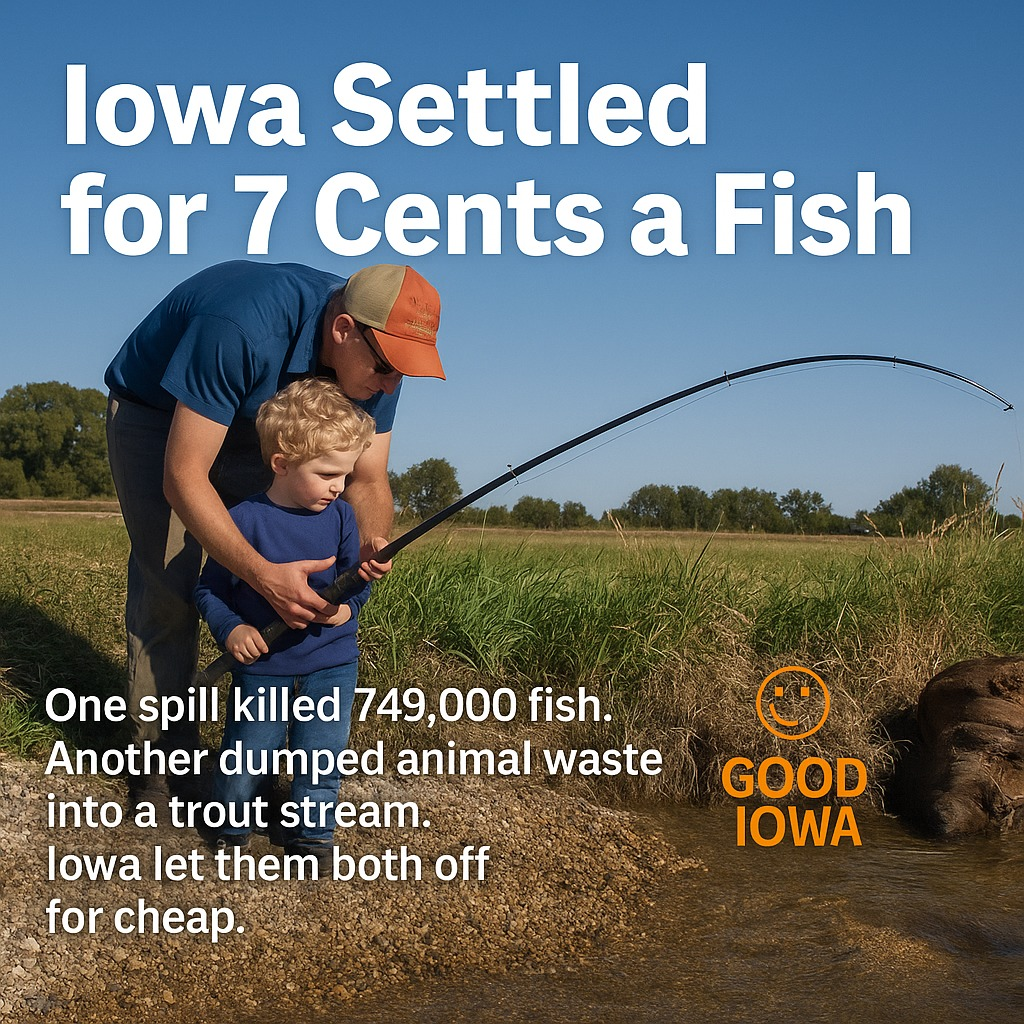
(July 31, 2025) In Iowa, if you want to legally catch a trout, it’ll cost you $14.50 for your trout fee. Add a $22 fishing license, and you’re paying nearly forty bucks a year to enjoy the quiet peace of a riverbank, rod in hand. And if you happen to catch one too many? That mistake could cost you $15 per fish, plus points on your license, and a suspension if it happens again (Iowa DNR Fishing Regulations, 2025).
But if you kill 749,000 fish by dumping 265,000 gallons of nitrogen fertilizer into an Iowa river? That’ll cost you seven cents per fish.
That’s the price NEW Cooperative paid after one of the worst environmental disasters in state history. And it’s the same story for Agri Star, a meatpacking plant with a long record of wastewater violations that has polluted a beloved trout stream and rural drinking water source in northeast Iowa.
In July 2025, Iowa Attorney General Brenna Bird announced settlements with both companies. NEW was fined $50,000 after its Red Oak facility released a quarter million gallons of UAN-32 fertilizer into the East Nishnabotna River, triggering a toxic fish kill that stretched nearly 60 miles and crossed into Missouri. The Iowa Department of Natural Resources (DNR) confirmed 749,242 fish were killed. The DNR estimated the ecological value of the loss at $225,000 (Iowa DNR Fish Kill Report, March 2024).
The fertilizer flowed from a blocked pipe that had been left open over the weekend of March 9, 2024. When the blockage cleared, the liquid nitrogen solution spilled into a stormwater drain, reached the East Nishnabotna River, and flowed south through Montgomery, Page, and Fremont counties before merging into the Missouri River (Iowa Capital Dispatch, May 2024). The affected communities include Red Oak, Shenandoah, and smaller rural areas where many residents rely on private wells for drinking water. The DNR and county officials issued nitrate testing advisories in the days that followed.
Meanwhile, in Postville, Agri Star Meat and Poultry was fined $50,000 after racking up more than 60 violations of its Clean Water Act permit. Investigators documented repeated discharges of ammonia, chloride, and suspended solids into Hecker Creek, which feeds into the Yellow River—one of Iowa’s few coldwater trout streams. The facility failed to report key violations and missed mandatory sampling for months at a time (The Gazette, July 2025).
This was no minor stream. The Yellow River runs through Allamakee County in the heart of Iowa’s Driftless region. It’s a destination for anglers, hikers, and conservationists. It’s also an impaired waterway under EPA standards, and rural residents in the watershed often rely on well water for drinking. In February, the citizen group Driftless Water Defenders filed a federal Clean Water Act lawsuit against Agri Star, citing “ongoing, unlawful pollution discharges into protected waterways” (DriftlessWaterDefenders.com, Feb. 2025).
Agri Star is owned by a Canadian-based firm that purchased the Postville facility out of bankruptcy in 2009. Despite the change in ownership, the plant has continued to face scrutiny for wastewater violations and noncompliance with federal permits.
If these companies had been fined the way ordinary Iowans are, the numbers would look very different. At $15 per illegally taken fish—the same amount a resident might pay for exceeding their bag limit—NEW’s penalty would total more than $11.2 million. Agri Star’s discharges, while not tied to a specific fish kill, occurred in a protected trout stream where any significant damage could result in fines, license loss, and even criminal charges for a private citizen.
The state’s response? A fine of $50,000 each—and a promise to do better later.
This isn’t the first controversary for either company. NEW Cooperative previously faced a 2021 lawsuit from Landus Cooperative over trade secret theft, resulting in a court-ordered injunction (The Messenger, Jan. 2021).
Agri Star is the successor to Agriprocessors, which shuttered in 2008 following more than $9 million in labor fines and a $600,000 federal settlement for dumping untreated slaughterhouse waste into Postville’s sewer system (EPA Consent Decree, 2006; Iowa Labor Commission, 2008). Today, Agri Star continues to face federal scrutiny for ongoing water pollution violations.
The impact of these events is more than ecological. It’s personal. In Montgomery County, where NEW’s spill began, residents questioned the safety of their water. The Iowa DNR distributed emergency nitrate testing kits through local health departments (Golden Hills RC&D, March 2024). In Allamakee County, the Yellow River’s future as a recreation and conservation resource is now in question.
“It’s not just about fish,” one angler told the Des Moines Register. “It’s about whether I can hand my kid a pole or a glass of water and not think twice” (Des Moines Register, April 2024).
This wasn’t just an accident. It was a choice—a choice to cut corners, to ignore safeguards, to treat rivers like waste channels and wildlife like collateral damage. And Iowa let it slide.
For two companies with long records of violation, $100,000 in fines won’t change much. It won’t restore the Yellow River or bring back the 749,000 fish killed in the Nishnabotna. It won’t rebuild trust for families who now question what’s coming out of their wells.
But it should make the rest of us ask a question: Why do everyday Iowans pay more to follow the rules than corporations pay to break them?
We deserve better. Our rivers deserve better. And the people who still fish, farm, and drink this water—they’re watching.
Sources:
Iowa Department of Natural Resources, Fish Kill Report, March 2024
Iowa Capital Dispatch, “Clogged Line Led to Massive Fertilizer Spill,” May 2024
The Gazette, “Iowa AG Bird’s Office Settles Two High-Profile Environmental Cases,” July 2025
Driftless Water Defenders Clean Water Act Complaint Filing, February 2025
Farmstand, Press Release, February 2025
Golden Hills RC&D, East Nishnabotna Spill Updates, March 2024
The Messenger, “Landus Sues NEW Cooperative,” January 2021
EPA Consent Decree, Agriprocessors Settlement, 2006
Iowa Labor Commission Penalty Report, 2008
Des Moines Register, “Anglers Respond to Iowa River Spill,” April 2024
Iowa DNR Fishing Regulations, 2025 – Bag Limits and Enforcement
Waukon Standard, “Agri Star and Running: Owner Optimistic,” August 2009